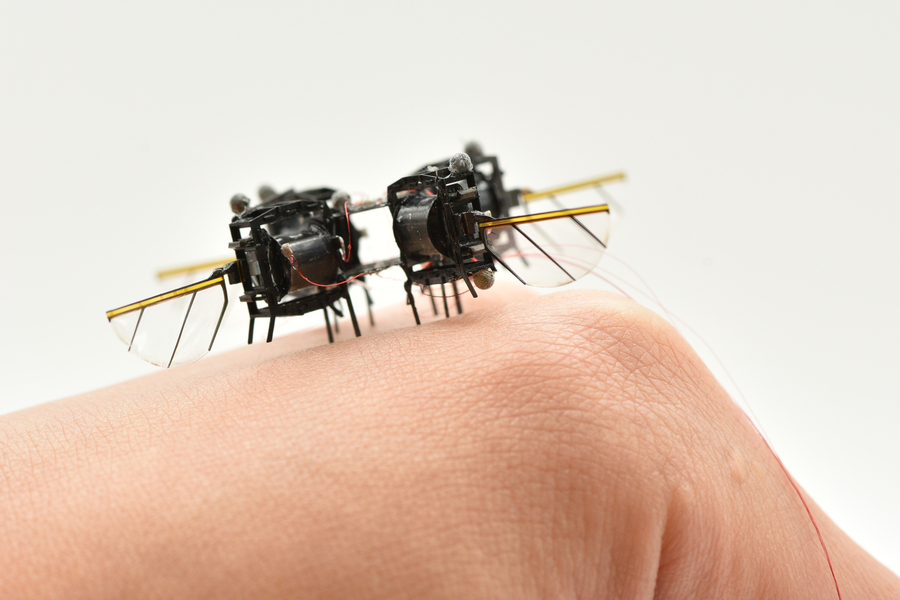
Tiny flying robots just got a lot closer to acting like real bugs. MIT engineers have built an insect-size aerial robot that can zip through the air, pull off gymnastic flips, and recover from gusts of wind with a level of speed and agility that starts to rival a bumblebee’s .
The prototype is roughly the size of a microcassette and weighs less than a paperclip, with four flapping wings powered by soft, artificial muscles that beat extremely fast . Earlier versions of the robot could fly, but only slowly and along smooth, predictable paths, in part because its “brain” was a hand-tuned controller written by humans . That limited how aggressively it could maneuver. To unlock insect-like flight, the team needed a controller that could handle messy aerodynamics and fast, complex moves without overloading the tiny robot’s computing budget .
So the group led by MIT associate professor Kevin Chen teamed up with control-systems expert Jonathan How to design a new two-part, AI-driven control scheme . First, they built a high-powered model-predictive controller—a planner that uses a dynamic model of the robot to simulate its behavior and compute an optimal series of actions for a given trajectory . This planner can handle elaborate stunts like rapid turns, aggressive tilts, or continuous somersaults, while respecting limits on the forces and torques the robot can safely generate, which helps it avoid crashing into obstacles .
On its own, though, that model-predictive controller is too computationally heavy to run in real time on such a small system . The researchers instead used it as a teacher: they generated training data and fed it through a deep-learning process known as imitation learning to create a “policy,” an AI model that can mimic the planner’s decisions much more efficiently . This policy takes in the robot’s position and spits out commands like thrust and torque in real time, compressing the expensive planning into something light enough for fast flight . How calls their robust training method the “secret sauce” that lets the policy learn everything it needs for aggressive maneuvers without drowning in data .
In tests, the results were dramatic. With the new controller, the tiny robot flew about 447 percent faster and accelerated 255 percent harder than in previous demonstrations from the same lab . It could perform 10 consecutive body flips in 11 seconds and still stay within roughly 4 to 5 centimeters of its planned path, even when wind disturbances tried to knock it off course . The team also replicated “saccade” movements seen in insects, where the robot pitches sharply, darts to a new spot, then pitches back the other way to slam on the brakes—behavior that could eventually help stabilize onboard cameras and improve navigation .
For now, the controller runs on an external computer and the robot flies inside a motion-capture setup, but the researchers see a path to pushing more of the intelligence onboard . They plan to add sensors and cameras so future versions can navigate outdoors, avoid colliding with each other, and coordinate their movements autonomously . Outside experts say the work is impressive partly because the robots manage precise flips and sharp turns despite manufacturing tolerances, meter-per-second wind gusts, and even their power tether wrapping around them mid-flight .
If this approach scales, it could reshape what microrobots can do. In disaster zones, swarms of insect-sized flyers might slip through rubble to search for survivors in places larger drones can’t reach . In the longer term, the MIT team hopes their architecture signals a shift for the micro-robotics field: proof that you don’t have to choose between high-performance control and computational efficiency, even at insect scale . The project is backed by funders including the National Science Foundation, the Office of Naval Research, the Air Force Office of Scientific Research, MathWorks, and the Zakhartchenko Fellowship, reflecting growing interest in tiny, agile robots that can share the sky with real insects.
Read more here.
 Sherin Shibu
Leave a comment